
- Home
- About UTS
- Admissions
- The UTS Difference
- Support UTS
- UTS Community
- Stories
- Contact

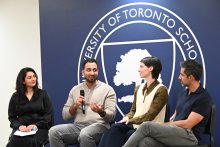
Entrepreneurship can take root by seeking to solve the problems facing the world, one of many inspiring messages shared by four UTS alumni entrepreneurs at The Entrepreneurial Mindset, a hybrid panel discussion for the UTS community presented by the UTS Alumni Association (UTSAA) and the UTS Parents' Association (UTSPA) this month.
The entrepreneurial mindset starts by deeply understanding the world we are living in, advised Ali Jiwani '09, co-founder of Slay School, which uses AI to help students personalize their learning by transforming notes, videos and course materials into study tools like flash cards, multiple choice questions and much more.
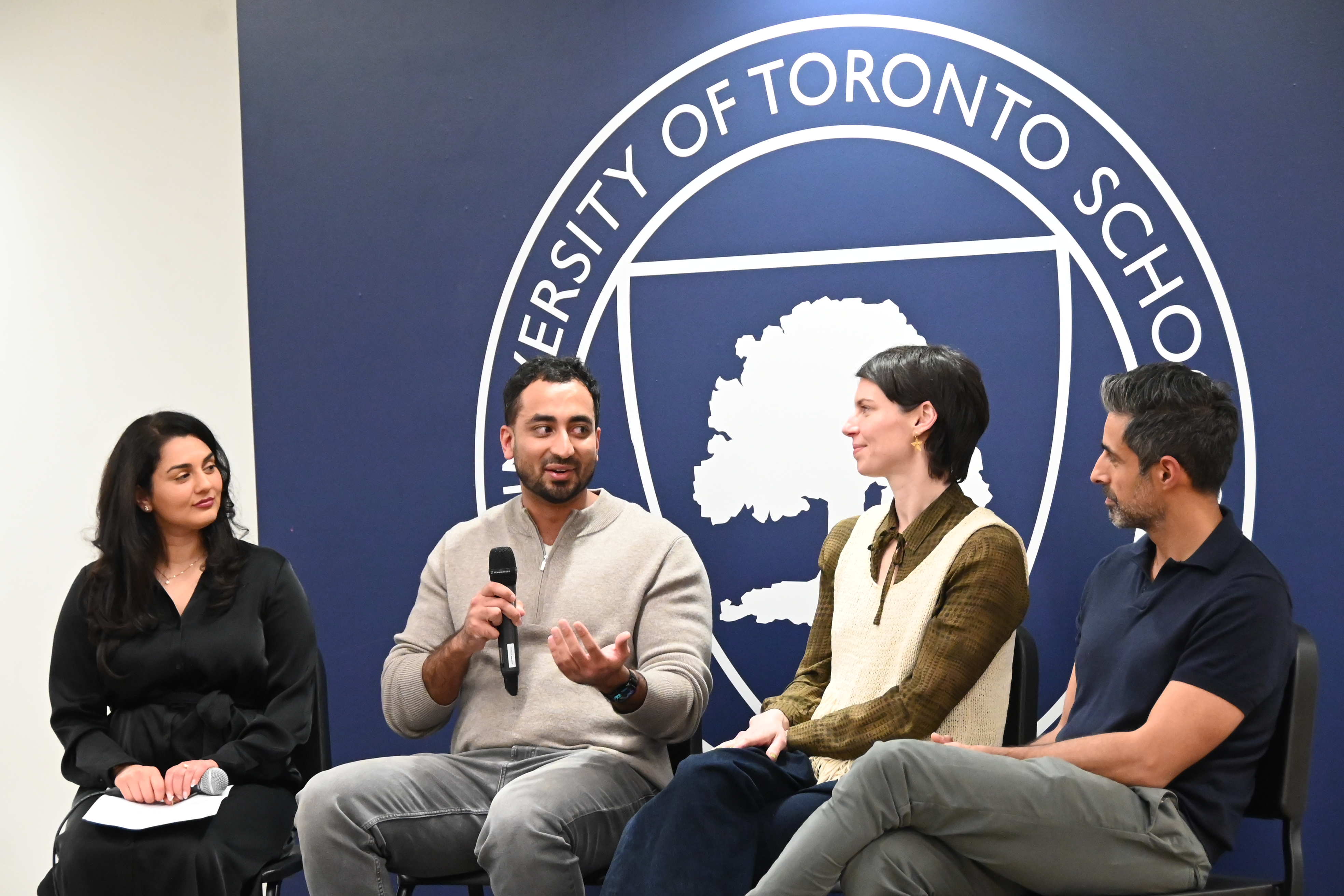
Moderator Hana Dhanji '05 with panelists Ali Jiwani '09, Nicole Campbell ’05 and Hafeez Ladha '03
Aspiring entrepreneurs can begin by asking themselves, “What do you want to change about the world?” he said. “Every day, you’re waking up and reading the news, seeing a ton of problems... That’s very powerful. When you're on the subway or walking on the street, and you see these problems still exist and ask, ‘How can I solve them?’ You are a citizen of the world; you're here to try to give back. I think that's the only way to really live.”
Ali added that by giving back, you experience joy and, if you’re good at what you do, perhaps achieve monetary success, too.
With the changing world economy, adopting an entrepreneurial mindset can be beneficial to all students, even if they don’t intend to become entrepreneurs, said panel moderator Hana Dhanji '05, UTSAA Board Director and Treasurer who is the founder and CEO of the enterprise learning infrastructure company Cognitrex Inc. “Roles are shifting. Entire job categories are being redefined by technology, and this includes AI. Increasingly, what's being rewarded is not just the depth of knowledge that we have… but the ability to adapt, create and build in environments of uncertainty. Tonight is about expanding how we think about success and exploring whether an entrepreneurial mindset might actually be one of the most important advantages you can develop, regardless of the path you choose.”
With diverse entrepreneurial experiences from retail to community building technology to AI and global finance, the panelists showed how a business can be high impact and profitable while also benefiting communities by supporting education, sustainable farming, investing and more.
Nicole Campbell ’05 co-founded Grape Witches, which specializes in organic, biodynamic and natural wines, with two retail stores, a patio, event space, wine agency and club and online shop. Her business enables the small producers they work with around the world, who use sustainable practices, to thrive. “Farming is really political,” she said. “A big part of my job now is travelling and connecting with all of those makers and having important relationships by representing their wine. Being part of a global community has shifted my perspective… I get to be part of the voice that's pushing through what I think is right in my own community and space.”
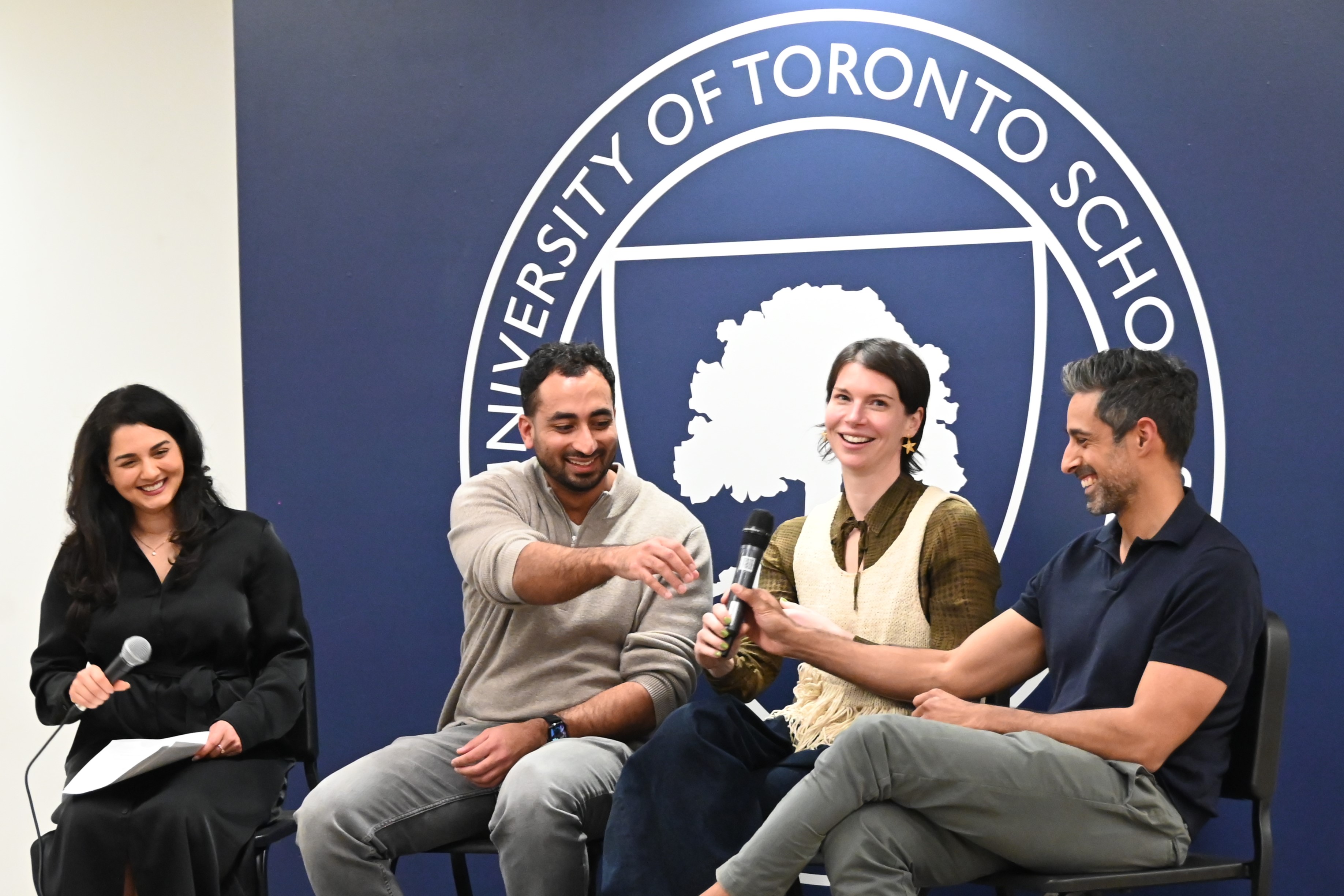
Hafeez Ladha '03, a founding partner of Sustained Impact Partners, makes a difference through finance. His company supports businesses to design socially focused investments, and with two decades of experience working at the intersection in finance and impact, his work has contributed to expanding access to essential medicines and even supporting the scale of the world's first malaria vaccine.
“Every human has a creative expression that yearns to be realized,” he said. “Sometimes that gets tamped down because of life, career, trying to make money and all the things, but keeping that expression alive is super-important for our own happiness. Those things have a place in your life, even if they are not currently making you money.” He said that many of his friends found joy in forms of creative expression for years before they turned their pursuits into profitable enterprises.
The panel discussed how failure is a formative part of the entrepreneurial mindset. Hafeez shared how he quit his job to seek nomination as a Liberal MP candidate in Canada’s 2021 Federal Election, certain he would win, and then didn’t. He gave it everything he had, and kept confidence in himself. “I don't need to look to external signs to validate that I can believe in myself. It is a choice I make every day, that I can do the things that I set my mind to doing. That shift from looking to external validation for approval to kind of looking within has been monumental for me.”
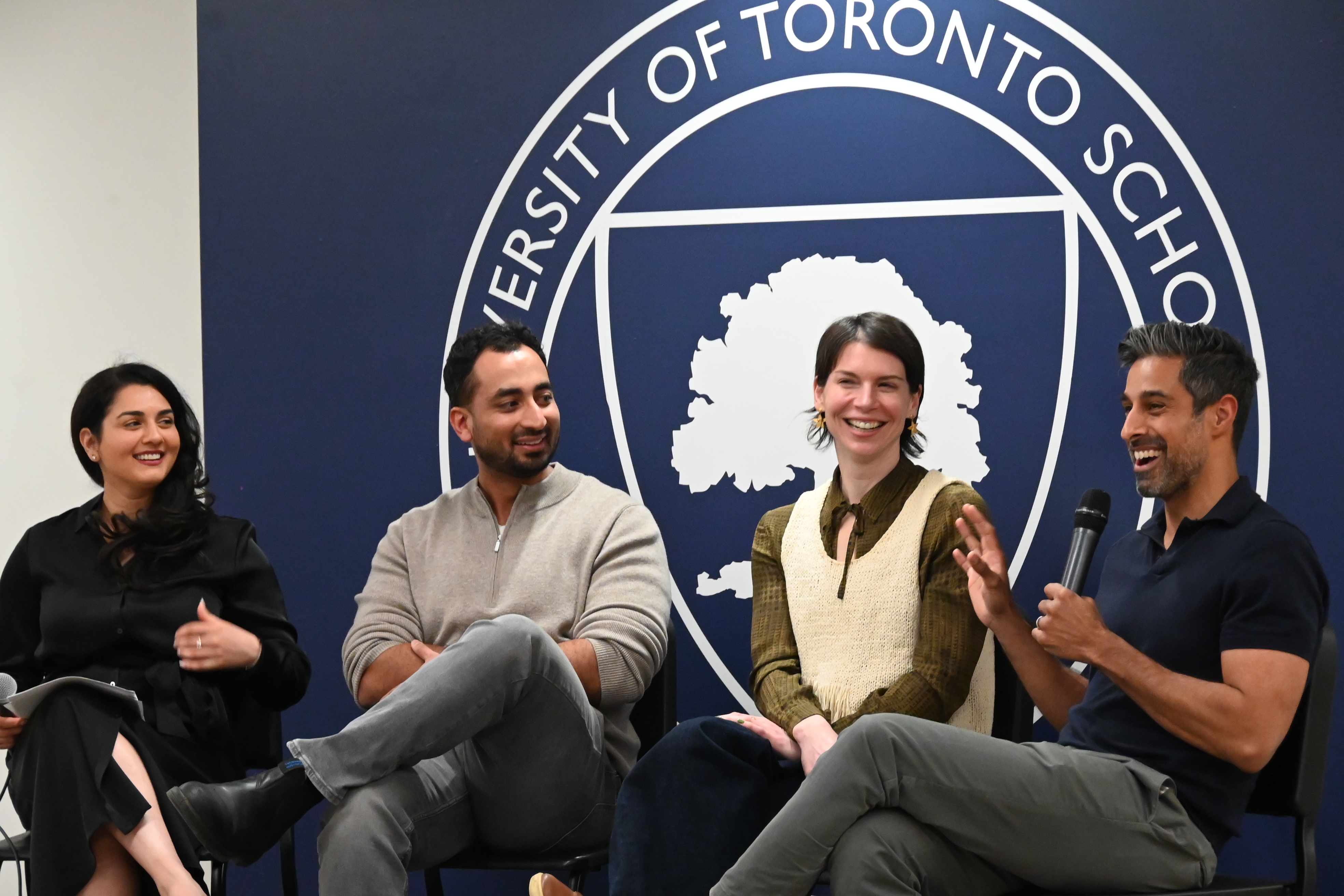
The ability to pivot and find a new angle is vital in the face of setbacks, said Hana. “When you become comfortable realizing you do have the ability to get back up, you are less easily taken out of the game. The people who make it aren't necessarily the smartest, most talented or the ones who have the best idea. They are the ones who stay in the game the longest. Just keep going.”
Ali’s first business was a food delivery platform called MealSurfers, aiming at disrupting the industry by launching before Uber arrived in Toronto. He went for smaller businesses like taco trucks and home cooks, while Uber got the big brands. A Filipino family, new to Toronto and struggling to make rent, approached him to join the platform and received $2,000 worth of orders, which he delivered himself. “When I delivered the food, she came to me crying, saying, ‘I was not going to pay my rent this month, but this business really made it happen.’ There was no class that taught me how to do business. I could just build this thing and I could help people, and it also makes money.”
He recalled how his parents questioned him about starting his own business: “What happens if you fail?”
“That's such a dumb question,” said Ali. “What happens if you succeed? What happens if the thing you're building actually works, your company grows and scales? What happens if the impact you're trying to have happens?”
Entrepreneurship carries risks, but so does not following your calling. Ali worked in procurement at a bank for two years for two years before launching MealSurfers. “The risk for me was if I continued down this path of working at the bank, that was going to be my future, and I did not want that.”
The high from building his first business lasted for a while. His next business was a video tech platform called Rally, competing with Zoom, that thrived during the Covid pandemic but lost a lot of customers when people returned to the office after the pandemic. Then Ali pivoted again, to launch Slay School.
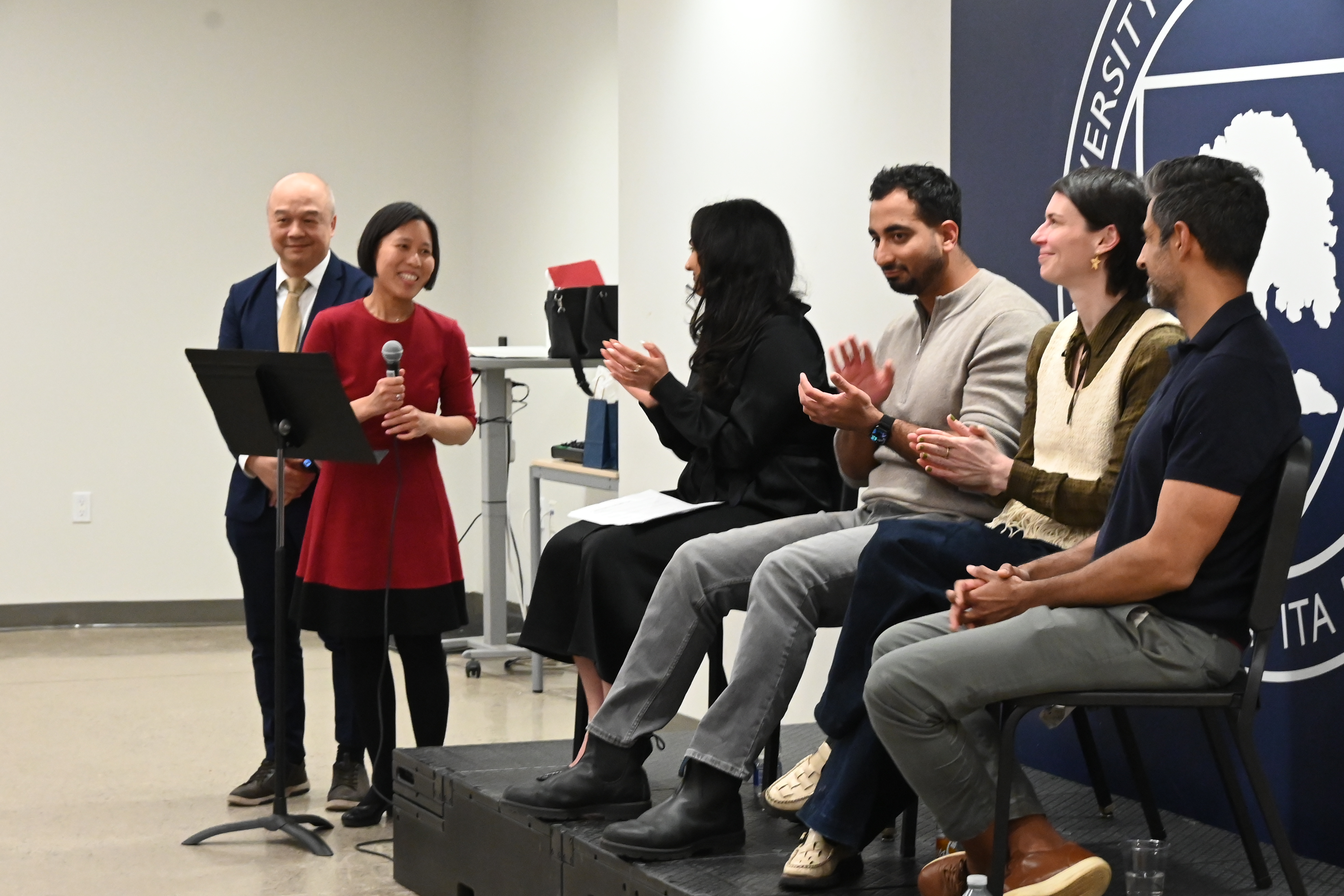
UTSPA General Meeting Coordinators Mark Bui and Janice Omoto, with the panelists.
Being an entrepreneur can take over your life but also creates room to live life on your own terms. Hafeez finds it gives him time now to start his mornings with his daughter and take her to pre-school, and pick her up at the end of the day. Nicole launched Grape Witches working every waking moment and realized that wasn’t how she wanted to live. She began striking a balance and living with intention. “On an average day, I take intentional moments for myself, and all of the other hobbies, passions and people in my life,” she said. “It's a mix of meetings and many emails and I think the most important part of my day is managing my managers. We do a lot of silly, fun things. I love trying to make a life for myself and other people where we discover the joy in every day.”
Nicole is also intentionally working less. “In 2026, part of being a good leader is to set an example of a positive workplace where you can have a life. It's a really important thing to model boundaries, and if you require your employees or yourself to consistently work those types of days, you're doing something wrong.”
When asked what they would change about their time at UTS, Ali shared things like having more self-acceptance, being less impatient and quick to judge. Nicole wished she had more fun and worked less. Hafeez said the imposter syndrome he felt in his younger grades led him to seek conformity. As he tried to be like everyone else, he lost some of what made him special when he could have accepted himself as he was.
But Hafeez’s greatest advice for students to develop an entrepreneurial mindset is to get out there, and leave Toronto, Canada and even North America behind. Each place he found himself in, from New York, South Africa, Kenya, Ethiopia, Tanzania, Ethiopia, Nigeria, Philadelphia, Washington, DC, Boston to London, U.K., made him think differently about the impact he wanted to have in the world.
“Expose yourself to different places, cultures, problems, economic structures and societal norms,” he suggested. “Through that exposure to new environments, the expansion of mind we can have is unparalleled ‒ the ideas, the belief in what is possible, the ceiling for what one can achieve naturally expands.”
Watch The Entrepreneurial Mindset.
#UTSStories





.jpeg&command_2=resize&height_2=85 "Connection for life: Avanti Ramachandran ’09 and Samir Kulkarni ’10")