- Home
- About UTS
- Admissions
- The UTS Difference
- Support UTS
- UTS Community
- Stories
- Contact
The pressure was on. One month before the VEX Robotics World Championships this April, UTS Robotics Team A Bello Bello! decided to wipe the slate clean and create a completely new robot design, and they needed all hands on deck to make it happen.
This is not an unusual strategy in competitive robotics. “Teams discover new tactics as they become more familiar with the game,” says Bello Bello! member S5 (grade 11) Anson, who serves as co-presidents on the UTS Robotics team with S5s Emerson and Daniel. “And the type of bot people build also changes. From the beginning of the year to before the World Championships, the robots were completely different. Every couple of months, we take another look at what's popular, what our previous iteration could have improved on and some of the things that we struggled on, and build a new design.”
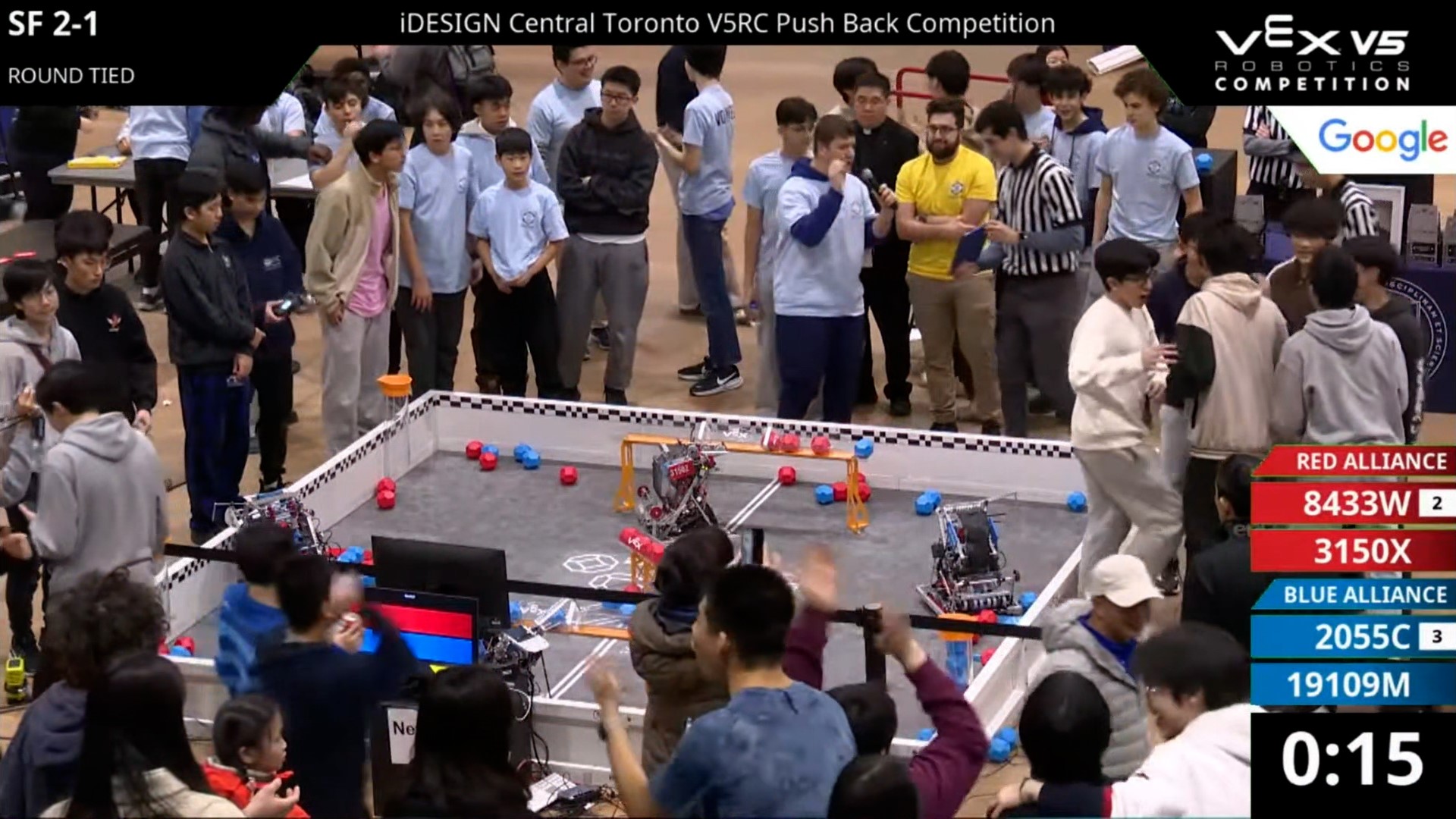
The UTS A and B teams (on the right side of the field) played together to advance to their first-ever regional finals at the iDesign Central Toronto Push Back Competition.
This year’s VEX Robotics game was called Push Back, where teams play their robots two on two in a 12 by 12 foot playing field to collect 18-sided plastic blocks and place them into scoring stations. Intense strategy is at play: when the scoring stations become full, teams bump out blocks by adding new ones.
Bello Bello!’s previous robot was C-shaped, scooping up the blocks from the bottom and then outputting from the same side, which they found complicated to build and hard to tune up. Before the Ontario provincials, Anson brought the robot home so team members could work day and night to refine it, sometimes as late as one or two in the morning.
A month before Worlds, they iterated to create an S-shaped robot. “It picks up blocks on one side with a funnel and outputs them on the other side of the robot,” says Emerson. “Our completely new design could move the blocks a lot faster because of the geometry and how many blocks we could hold.”
To build a new robot in the month before Worlds, UTS Team A, which consisted of about 12 members, called on the strength of the UTS Robotics Team.
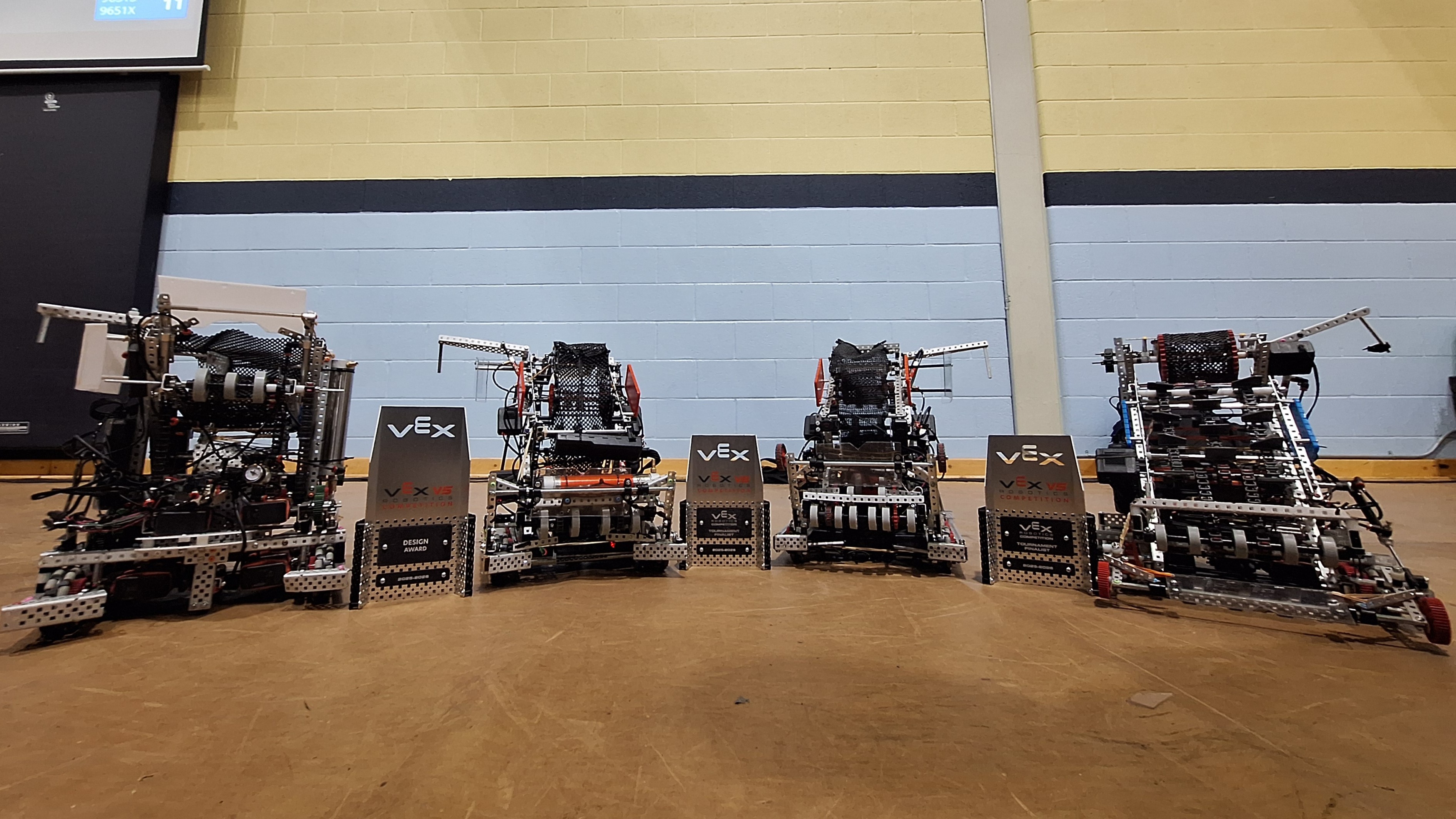
The UTS robots at the iDesign competition hosted by St. Michael’s College School from left to right: the UTS girls’ team, the B team, A team and middle school team.
UTS Robotics has grown substantially, from about 20 members in the 2024-25 school year to about 80 this school year. Starting in fall 2025, UTS hired Owain Jones, who had taken a robotics program at Carnegie Mellon University and led robotics programs at the Toronto District School Board and St. Clement’s School, as robotics program director and computer science teacher. Students were also given a dedicated space to refine their creations.
To further the growth of robotics at our school and to share their knowledge with others, Emerson, Anson and Daniel launched a March Break Robotics Camp at UTS in 2026, with some of the places being provided to students from traditionally underrepresented groups. During the week-long program students built their own robot and then competed in a mock tournament at the end of the week. The Robotics Camp will also run in the summer for two weeks.
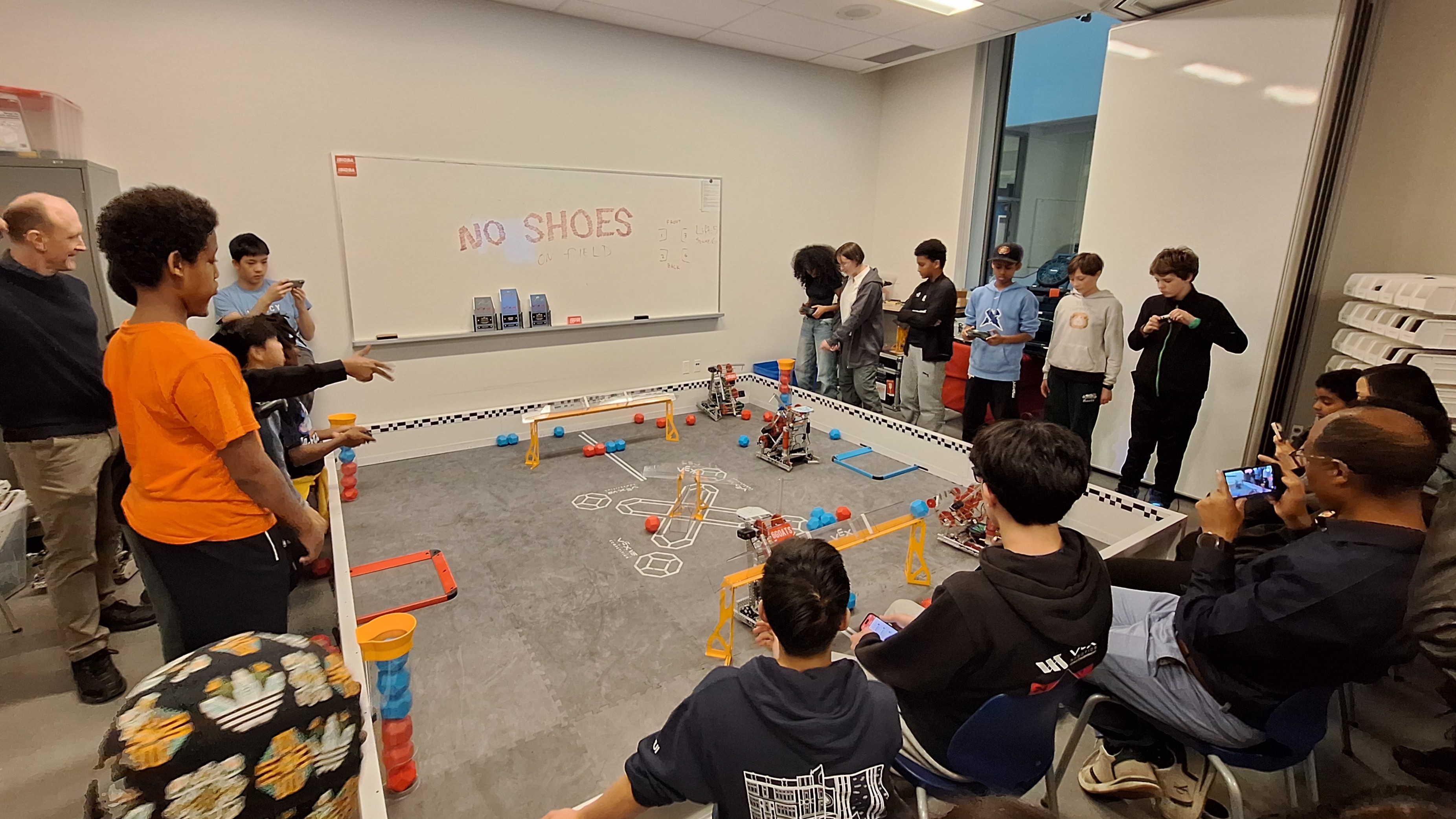
At the Robotics March Break Camp, students spent the week creating robots for the tournament on the last day of camp, where their families came to watch.
This year, UTS Robotics had four competitive teams: the UTS A and B teams, a middle school team which also competed at Worlds, and a dedicated girls’ team.
“We benefited so much from inviting the other UTS teams to work on the robot,” says Daniel. “Not only did they benefit from having the experience of going to Worlds, they gave us a helping hand, where we had so many more people that were able to drop in and work on the robot to make sure that something is always being done.”
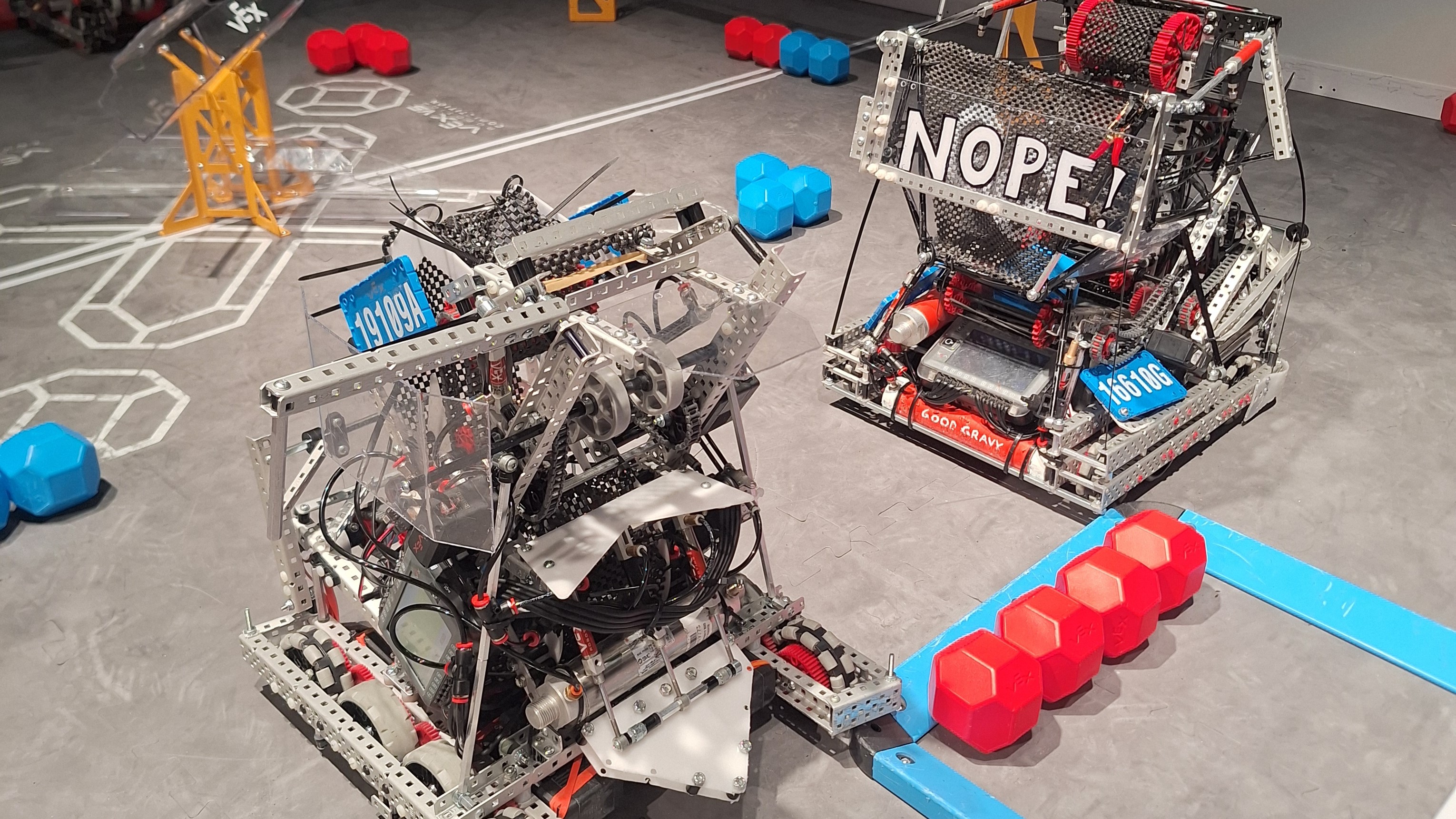
The UTS A team Bello Bello!'s robot left plays a team called Good Gravy at a competition hosted by Woburn Collegiate Institute.
Robotics is true teamwork as its core. Some students are coders, creating the robot’s programming, while others are builders, developing its physical structure. Students drop in at lunch and after school to further their designs, recording the work that was done and the next steps. In the competition, only three students per team are on the playing field, one driver to control the robot and two coaches, one who liaises with their alliance partner team that they play with and one to provide strategic advice to the driver.
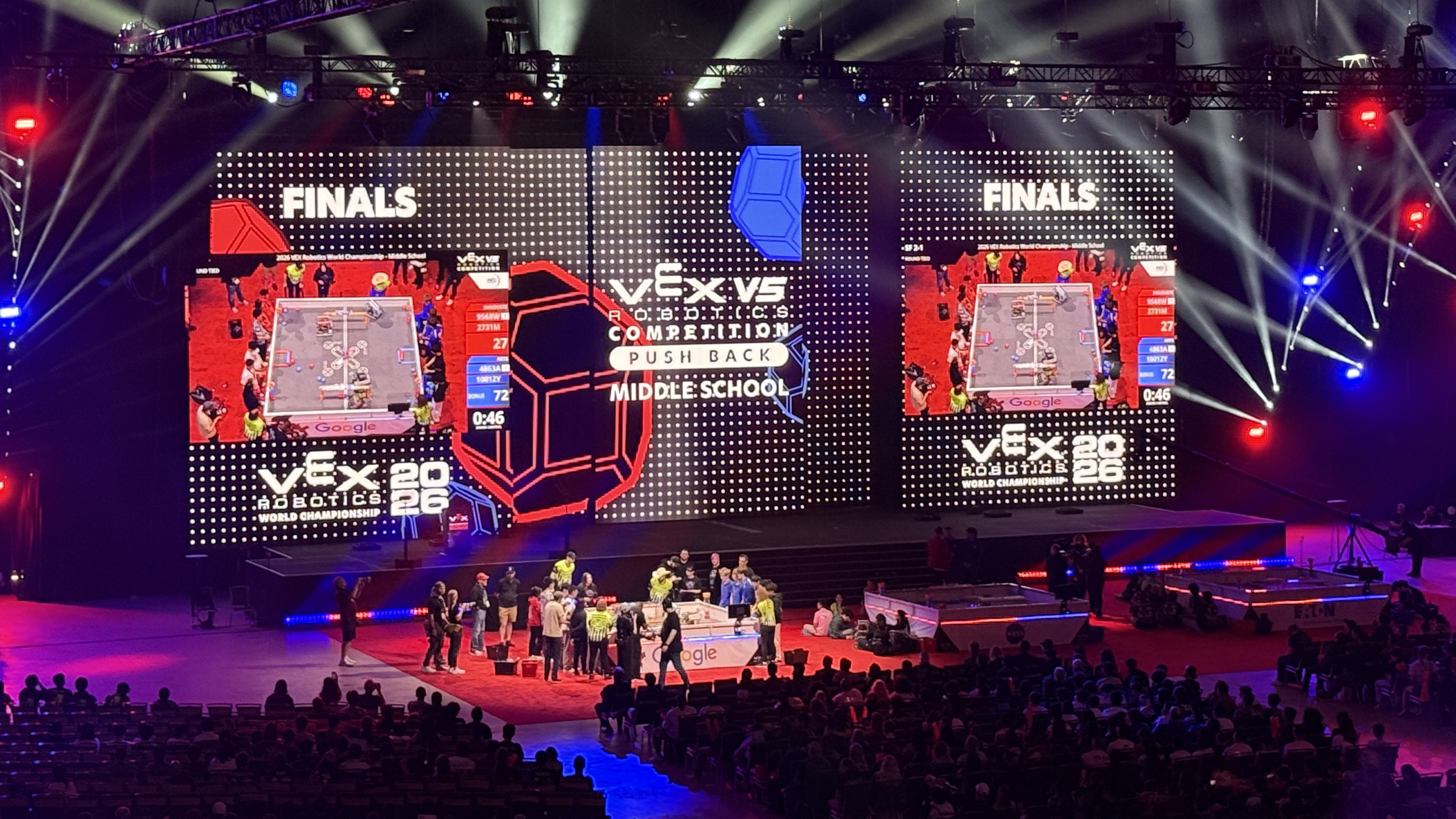
The UTS teams had the opportunity to watch the VEX Robotics World Championships grand finals in the stadium, where the top four teams compete.
About 40 UTS students attended the VEX Robotics World Championship in St. Louis, Missouri and experienced the excitement of this incredible competition. Emerson says: “For us the accomplishment is getting there because we know how hard it is to do that, and doing our best to constantly improve and perform well on the world stage. We're grateful that we've been able to go for three years in a row. And it’s really cool to see how other countries approached the exact same problem, and how they were sort of able to iterate it in their own way.” At worlds the students bonded as a team, and enjoyed fun activities outside the competition, visiting a local museum, going to Top Golf and enjoying meals as a team. As Owain points out, VEX Robotics competitions also include teams from professional organizations and private academies, so the event provides an opportunity for our students to see some of the best robotics in the world.
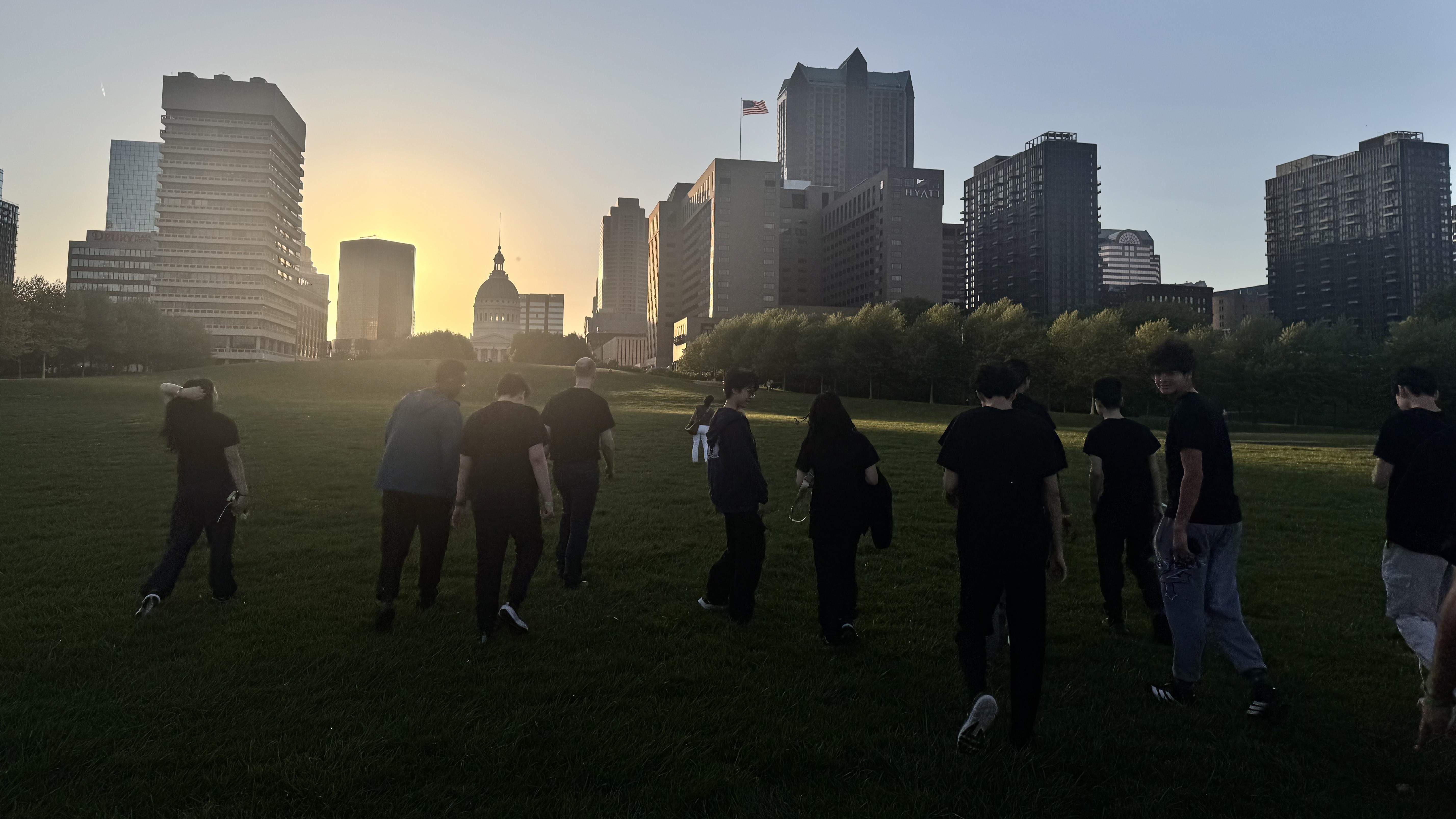
At the VEX Robotics World Championships, the UTS Robotics team took some time out to see St. Louis together.
For the middle school team, which had about 20 members, the week before competition was non-stop, with students putting in about 70 hours that week. “Every single game at Worlds was so exciting, because as the coder I was on the drive team right beside the field,” says M3 Dev.
The team, which excels in the autonomous part of the competition where the pre-programmed robot steers itself, made it to the quarter-finals, an impressive achievement.
“It was really cool to see all the different teams and cultures from all around the world… VEX Robotics is primarily U.S.-based but it was especially cool to see the amount of foreign teams – our alliance partner was a Chinese team.” says M3 Khalil.
The UTS girls team called Fish and Chips received a design award for their robot name Ketchup at one of the regional competitions for their unique power transfer system. “The girls’ team has grown a lot,” says team member S5 Sidney. “Last year there were five team members, all in my grade. This year we had many more people from across different grades and it has been great to see some of them who were completely new to the Robotics Team learn and improve over the year.”
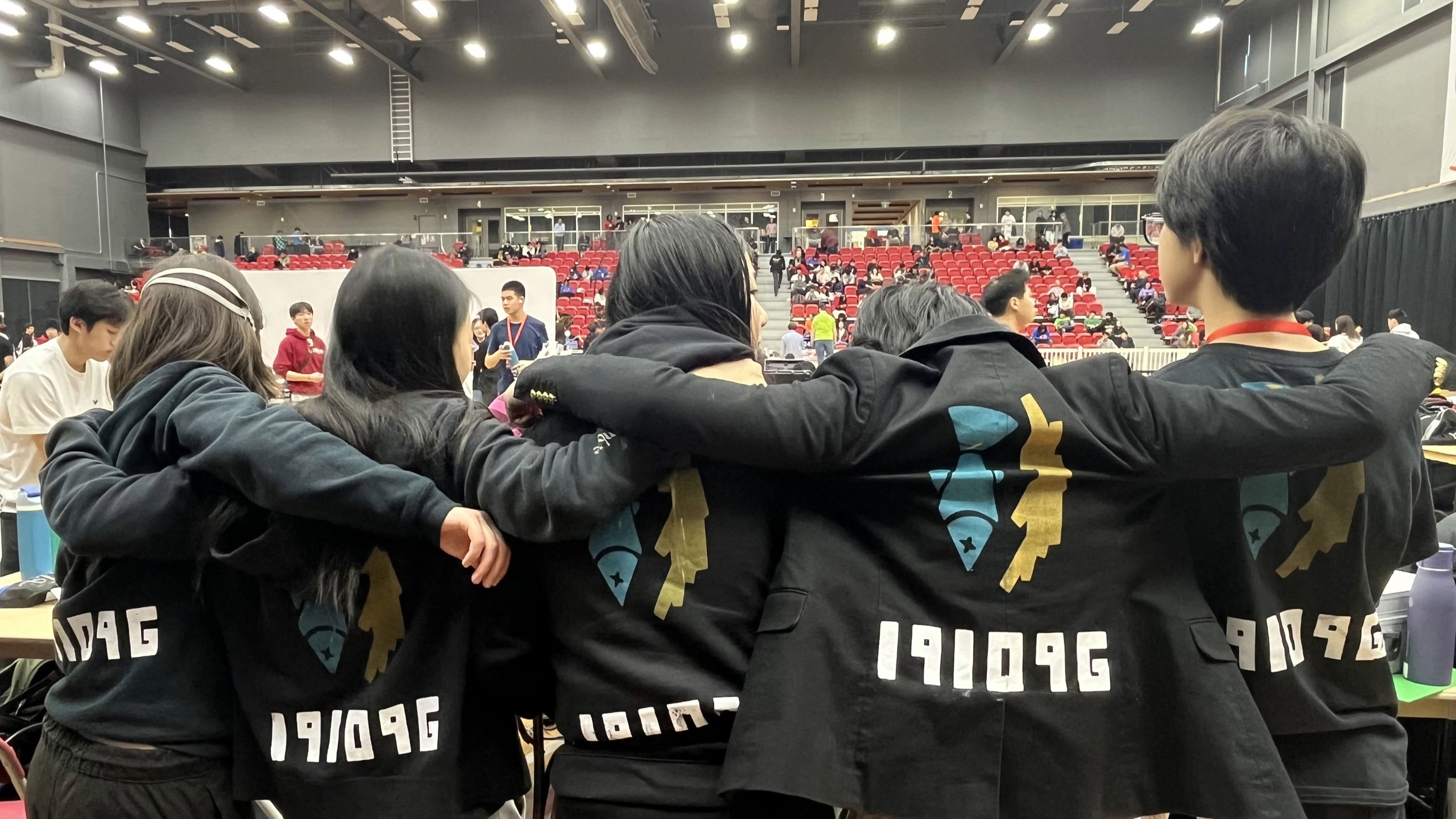
Some of the members of the UTS girls robotics team.
Next year, the UTS Robotics team plans to build on its successes and involve more students, adding another middle school team. The teams have been selected and the work has already begun on the 2026-27 V5 challenge: Override, where teams will use their robots to collect pins and cups to stack on the goals.
Owain says, “I really love how they can put their learning into action and work together to solve these challenging problems. They learn the different aspects of robot design, but more importantly, they learn how to work in a high-pressure environment as a team and give positive feedback, focusing on the process instead of the people.”
#UTSStories



_00_01_55_04_Still002(1).jpg&command_2=resize&height_2=85 "The sound of hope and renewal: National Day for Truth and Reconciliation Assembly")