- Home
- About UTS
- Admissions
- The UTS Difference
- Support UTS
- UTS Community
- Stories
- Contact
.jpeg?command_1=resize&width_1=220 "UTS students compete on Dragon’s Den, speak at the UN and launch a video editing business")
University of Toronto Schools (UTS) students are proving that innovation doesn’t need to wait for high school graduation. During the 2025-26 school year, UTS high school students successfully pitched a business on Dragon’s Den, spoke at the United Nations about the electricity-free washing machine they created and continued to build an innovative animation and special effects video editing business.
For these students, innovation begins with looking closely at the world around them, identifying challenges and opportunities, and imagining new ways forward.
For S5 (grade 11) student Edlyn, it began two years ago when her sibling Nico had a friend who was wrongly accused of using artificial intelligence to complete a school assignment. In a month, she and her sibling worked together at Toronto Metropolitan University’s DMZ Basecamp program to launch a Chrome extension called Aidify that can track student activity in Google Docs, giving teachers a tool to help verify the authenticity of their students’ assignments.
To pilot the tool, Edlyn sought the support of Jenny Pitt-Lainsbury, UTS vice principal of academic operations.
“Piloting it at UTS was great because Ms. Pitt-Lainsbury, who was one of the first teachers to ever hear about it, was very supportive,” says Edlyn. “She arranged a meeting with UTS department coordinators, and UTS teachers have been using Aidify for a few years now.”
The vital feedback provided by UTS teachers helped evolve the app, and it grew from there. Edlyn and Nico, now a biomedical engineering student at Waterloo University, raised $18,000 in pitch competitions and then decided to take their chances with Dragon’s Den.
.jpeg)
S5 (grade 11) Edlyn with her sibling, Nico, as they pitched their Chrome extension called Aidify on Dragon’s Den.
“Dragon’s Den was really surreal,” says Edlyn. “We applied, sort of on a whim, to see where it would take us. We didn't expect it to become this big.”
They pitched Aidify on Dragon’s Den in January seeking $10,000 for 50 per cent equity stake in their business. Instead, all five dragons went all in – offering a total of $50,000 for 50 per cent equity. “We see the future of Canada in front of us right now,” said Dragon Wes Hall.
Edlyn joined UTS as an M3 (grade 9) student after attending the UTS Girls in Tech Conference, organized by UTS students for girls in grades six to eight. Now she’s a member of the executive team that organizes the conference. She’s also very active on the UTS Debate Team, and credits the impromptu speaking competitions for preparing her to field the tough questions in the spotlight on Dragon’s Den.
Aidify now has 5,000 users on the Chrome Web Store and is continuing to grow.
“The publicity from Dragon’s Den has opened up many more opportunities,” says Edlyn, who is entering her last year at our school. “I'm really excited to see where it will take us in the future, because we have ideas on how to make Aidify better for teachers and students. The investment is great, but it’s more the mentorship and the connections it brought us that have been very useful.”
.jpeg)
Nico and Edlyn at the end of the show on Dragon’s Den.
In December 2024, S5 (grade 11) Rhiya had a similar experience of observing a problem firsthand and devising a solution to solve it. Her family is Guyanese, and while visiting Guyana for the first time, she had the opportunity to take a boat ride to Santa Mission, a rural Amerindian village, which she describes as relatively well-off. Only two hours from the capital of Georgetown, Santa Mission now has minimal Internet access and some piped water, but when she first visited they didn’t. “While I was there, I had the opportunity to speak with some of the women about general problems in their community, and one woman told me how much time she and her daughter spent doing laundry – and it was a lot of time.”
Laundry was primarily the responsibility of women and girls, who bend over for hours in the creek, scraping clothes with bristle brushes.
That day, as the boat motored back down the Demerara River towards Georgetown, Rhiya began sketching plans for an electricity-free washing machine. “I started thinking about what I could do, because I always try to help when I can.”
Later during her trip, she met with the Guyanese Minister of Amerindian Affairs, the Honourable Pauline Campbell-Sukhai. “I asked her and if she thought that an electricity-free washing machine was a viable solution, and if it was, would I be able to work with them to bring it into these communities? She liked my idea and gave me the contact for her project manager.”
The Ministry of Amerindian Affairs also agreed to fund transportation for the prototypes to rural communities in Guyana, including those only accessible by boat and bush plane.
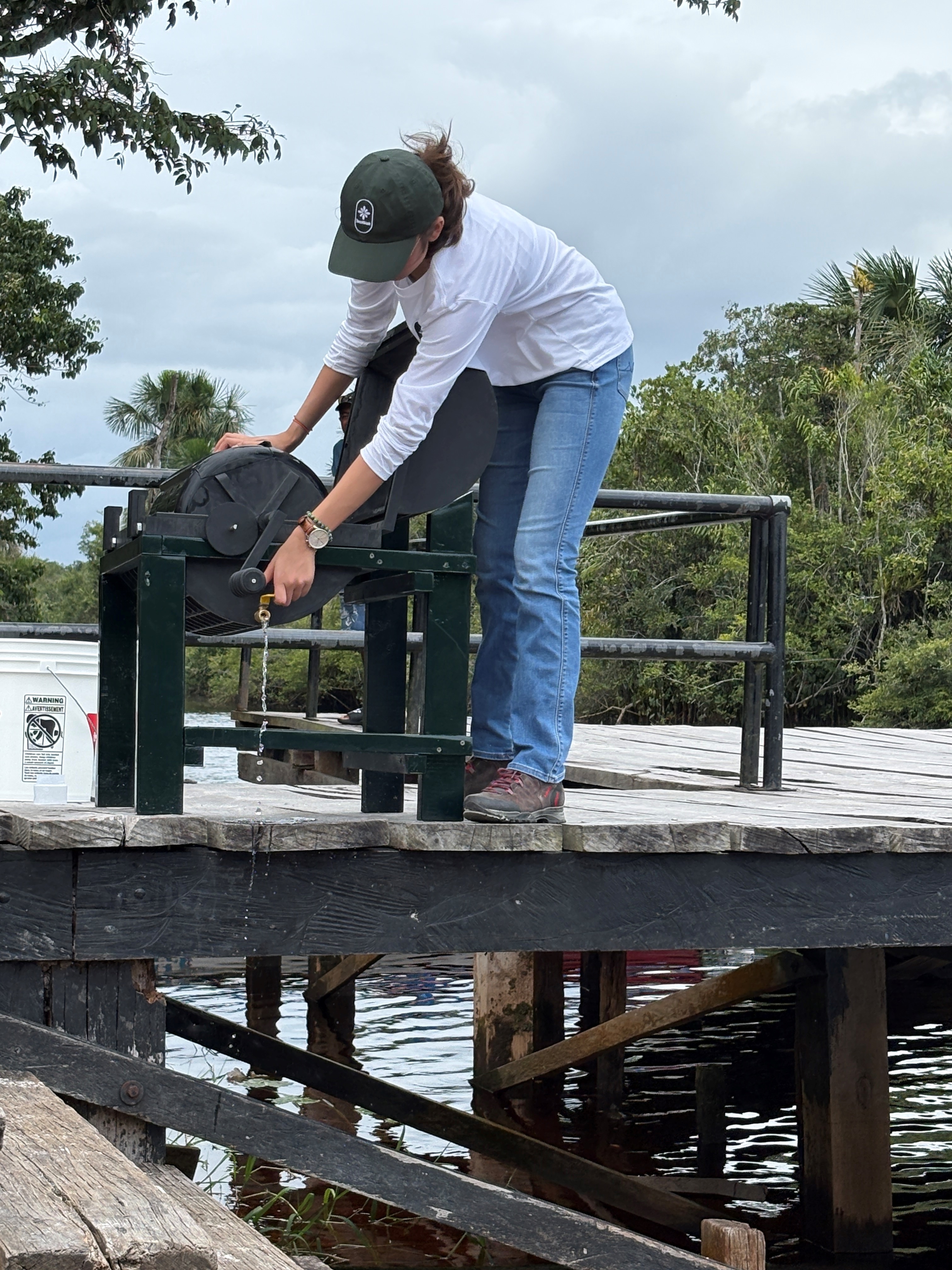
UTS student S5 Rhiya took the TerraWash Machine back to Santa Mission in Guyana to be tested by women and children in the Amerindian community.
Rhiya worked with the project manager for a year, going back and forth to refine the design using CAD software, and the TerraWash Machine was born. The idea is beautiful in its simplicity: the machine uses a hand crank and two gears so it does not require much physical energy to operate and can wash and dry clothes. It is designed to be printed on a 3D printer, with the idea that it could be made anywhere in the world. Rhiya established a Canadian-based non-governmental organization, TerraWash Global Associations, to oversee the project.
Having the support of the communities Rhiya designed the machine for was crucial. In February 2026, she brought the TerraWash Machine prototype back to the women and children of Santa Mission. There were about 40 children on hand to test the machine who gave feedback that it was fun and easy. The Ministry’s community development officers organized a meeting with some of the women to get their opinions on the machine and see if they would use it.
In May this year, Rhiya was nominated as a youth stakeholder to the United Nations’ Economic and Social Council’s Multi-stakeholder Science, Technology, and Innovation Forum in New York City by the Paris-based Learning Planet Institute. A youth fellow with the Institute, Rhiya took part in its Youth Ventures program for young people aged 14 to 18 who are concerned about global issues and want to take concrete action.
At the U.N. forum, she had the opportunity to speak briefly about her project and how it aims to alleviate time poverty experienced by women and girls in Guyanese rural communities.
.png)
Rhiya spoke about the TerraWash Machine at the United Nations’ Economic and Social Council’s Multi-stakeholder Science, Technology, and Innovation Forum in New York City.
“In 60 per cent of the world, five billion people still wash their clothes by hand,” she told the forum. “In some Guyanese communities, women and girls spend 14 to 20 hours a week washing their clothes. That's time that could be dedicated to education and pursuing further opportunities. When they have more time, a high percentage of women start their own micro-enterprises. It also allows older women time to rest, and younger girls time to pursue secondary education.”
During the event, she had the opportunity to meet Aarti Holla-Maini, the director of the United Nations Office for Outer Space Affairs (UNOOSA). “The week before, I was chairing UNOOSA at the Southern Ontario Model United Nations Assembly hosted by UTS. The entire time I was at the UN, I was very much in awe of being in the actual United Nations building.”
While the TerraWash Machine is designed to run without electricity, it can also be attached to an electricity generator so it won’t become obsolete as communities electrify. It also helps address health issues – repeated bending and motions of hand-washing can lead to musculoskeletal disease, and time in creek water can expose children and women to numerous pathogens.
Rhiya has applied for various grants to fund her social venture and has received mentorship from former Ontario premier Bob Rae. This summer she plans to head back to Guyana with 100 units, having recently won funding from Rideau Hall Foundation’s Ingenious grants for youth age 14 to 18 innovation.
This is not Rhiya’s first venture: with her sister Aarya she launched Stash, a miniature therapy horse that provides equine therapy services through the community organization One Health Partners. She also launched Poiesis, a poetry competition for high school students.
“I was never told that I couldn't do something if I put my mind to it,” she says. “A lot of it is from my family, but that also came from UTS as well.”
During the long pandemic days of online school and social distancing in the early years at our school, Declan ’26 and John ’26 dealt with their boredom by learning everything they could about video editing. As provided to all students, UTS gave them access to the Adobe Creative Suite, with Premiere Pro and After Effects, and they fell in love with it. John, who enjoyed playing video games, began making compilations of his best gaming moments to share online, while Declan shared anime edits of some of his favourite shows.
As their prowess with the programs grew, their videos became more sophisticated, and John’s work in VFX special effects and Declan’s in animation and motion graphics attracted attention. Their work is like magic: they can make rain where there was none, transform a scene from daylight to night, seamlessly blend videos and make logos come to life. They were given the opportunity to work on a music video in exchange for the experience, and that became their first portfolio piece. Demand grew with their skill level, and by their S5 and S6 years at UTS they were sometimes being flown down to Los Angeles and New York City to work on projects.
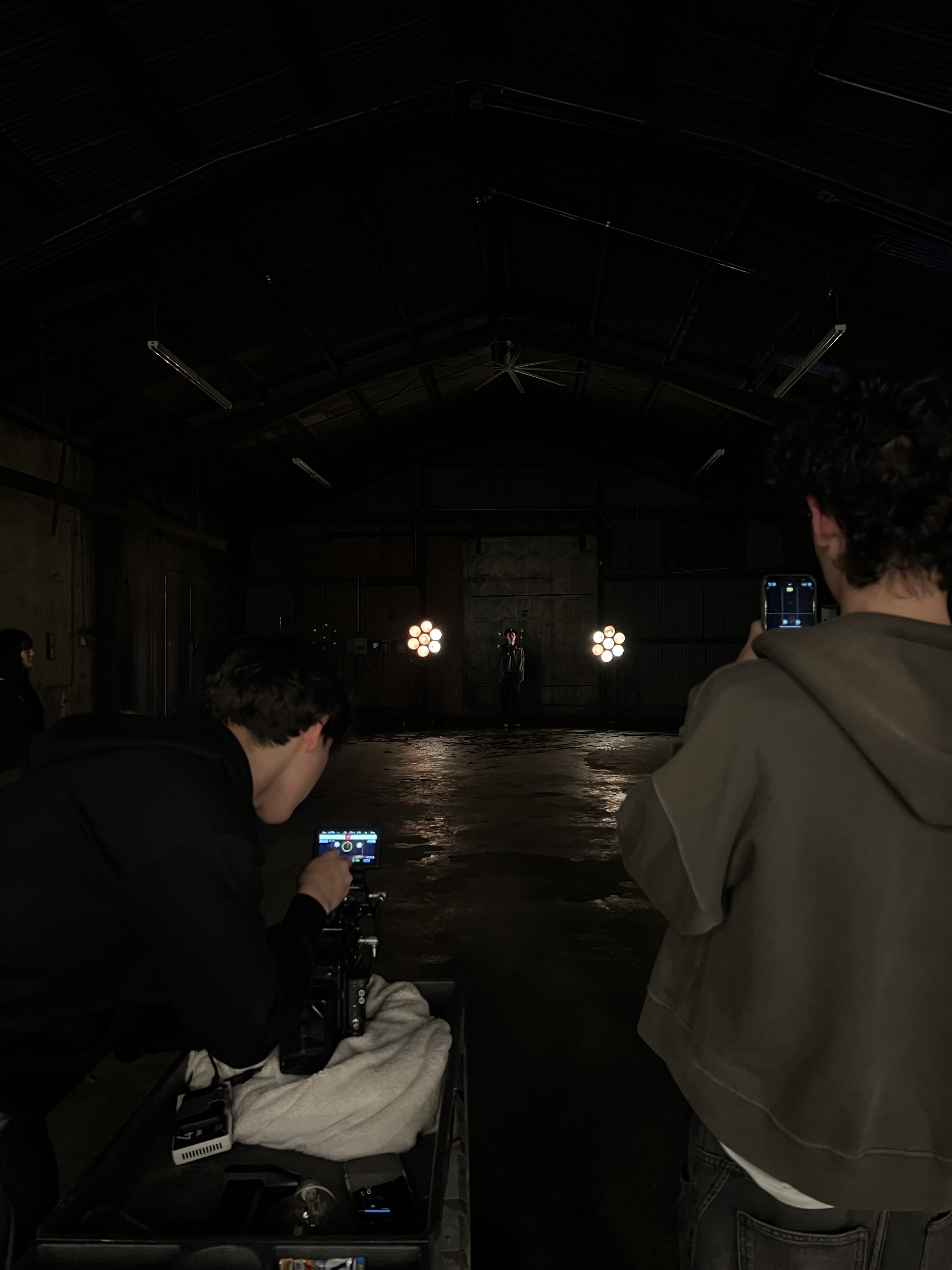
Declan and John direct a clothing campaign shoot in Los Angeles in June 2025.
While they weren’t in business together, their skills complemented each other’s, and they often collaborated on projects. This spring they were the compositors for a riveting National Football League project called Rookie Premiere, adding strobe lighting, special effects and graphics. They collaborated on advertisements for U.S. rapper Don Toliver’s Octane Tour VIP experience and a collaboration between the Puma sportswear brand and the celebrated footwear designer, Salehe Bembury. Over March Break 2026, John flew to Los Angeles to work on the Father video for Kanye West and Travis Scott, and collaborated with Declan to combine the videos of a knight on a horse with a church congregation, so it seamlessly appears to have been filmed together.

A screenshot from the National Football League project called Rookie Premiere, where John and Declan lent their VFX and animation talents.
Declan created animated stage visualizers for Rolling Loud, an international hip hop festival, which he attended and saw his work on display behind the performers.
Together, they’re extremely agile. “Declan and I are known for very fast turnarounds, and because our role in VFX is just one link in the entire pipeline of creating a video, being very reliable is one of the most key assets,” says John. “Also, because we are young and can work through the night.”
The services they offer meet a niche demand. “There's a kind of missing place for independent people in VFX that we're filling,” says Declan. “There's a lot of VFX houses with many employees that are LLC Corporations and can charge high rates for simple projects. We make ads look good for a good price, filling that gap.”
Because they’re independent, they are free to offer more creative direction and insight, which is also in demand, and are also interested in being involved in other parts of the creative process such as photo shoots.
This fall, John plans to continue his VFX learning curve, with nearly a full scholarship to specialize in VFX and animation at Chapman University, conveniently located near Los Angeles. Declan is headed to study computer science at Queen’s University, but plans to continue working on his animation and motion graphics business remotely.
Declan adds, “I think a lot of people are worried about the AI takeover of creative fields like this as more AIs roll out. But really large corporations need to know it’ll be perfect. They don’t want an AI to get it even one per cent wrong. In these really specialized fields, I think there’s a lot of worry that you don’t need right now.”
#UTSStories




_00_01_55_04_Still002(1).jpg&command_2=resize&height_2=85 "The sound of hope and renewal: National Day for Truth and Reconciliation Assembly")